
Jira Encryption
The StratoKey Cloud Data Protection Platform secures sensitive data destined for Jira with FIPS 140-3 validated field-level encryption and tokenization, protecting standard fields as well as custom fields and attachments, before data ever enters Jira.
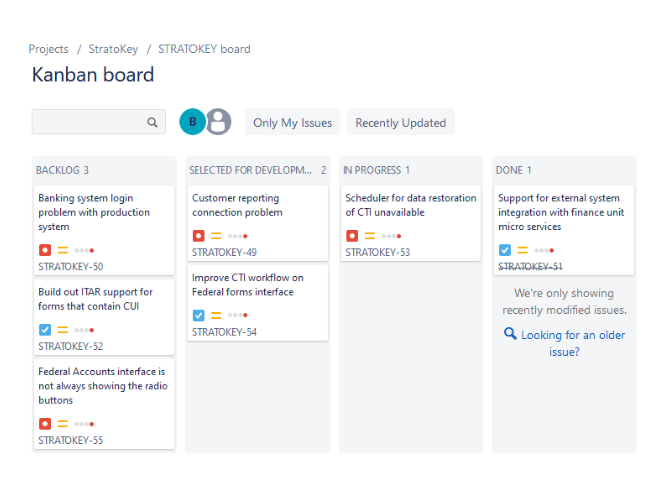
Jira Integration Features
- Supports securing Jira Cloud incl. Standard, Premium and Enterprise.
- Secures Jira Service Management to protect incidents, requests, and change workflows.
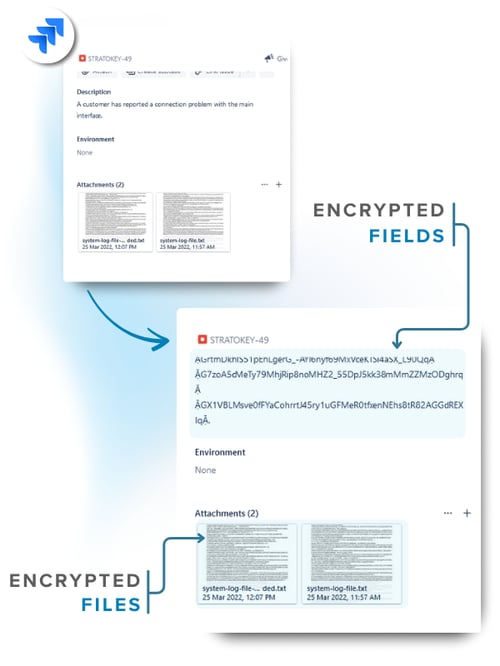
- Field-level end-to-end FIPS 140-3-validated encryption of standard and custom fields.
- End-to-end encryption of files.
- Organizations can encrypt content across Jira as a whole or in defined zones.
- Tokenization of standard and custom fields.
- Tokenization can be used to store your regulated data in your FedRAMP high environment.
- Supports both Jira Cloud and Data Center for flexible deployment.
- Integrates with Single Sign-On and SAML for seamless authentication.
- Provides audit logs and security analytics for tracking access and compliance.
- No endpoint configuration required, so Jira Service Management tickets like customer requests or bug reports can be encrypted at the origin.
- Secures other Atlassian products such as Confluence.
Meet Jira Compliance Requirements with Confidence
StratoKey helps you bring Jira Cloud into compliance with ITAR, CMMC, HIPAA, CCPA, GDPR, PIPEDA and data sovereignty regulations by encrypting and tokenizing sensitive data before it reaches Jira.
- Provides to-standard (FIPS 140-3 validated) encryption helping meet encryption cave-out rules across many regulations.
- Meets data security requirements aligned with NIST 800-53 and NIST 800-171.
- Provides capabilities to store data locally in sovereign, FedRAMP or GovCloud environments to meet regulatory requirements.
- Provides granular audit controls to assist with requirements for reporting obligations.
 Unlike plugins hosted within Jira, StratoKey operates independently in your own environment (cloud or on-premises), ensuring your data privacy and compliance posture are under your control.
How to meet FedRAMP High while using Jira Cloud with Tokenization
Jira Cloud is FedRAMP Moderate, not High. StratoKey’s CDP Gateway bridges this gap by tokenizing data before it enters Jira, storing sensitive values in your FedRAMP High–authorized environment within an encrypted vault (FIPS 140-3 validated encryption). Authorized users see data seamlessly detokenized in Jira, enabling compliance with FedRAMP High, CMMC, and ITAR without disrupting workflows.
How Does SaaS Native Encryption Compare with the CDP Platform?
The issue with SaaS native encryption is that the SaaS product performs the encryption and decryption of the plain text data. This data handling exposes your raw sensitive data to the SaaS platform. Conversely, with StratoKey, encryption is performed independently of Jira and the Atlassian stack. Decryption with StratoKey is provided on a privacy-first basis. Users must be authenticated through the StratoKey Gateway and have the appropriate access permissions to view sensitive information. This prevents unauthorized third-party access and delivers first-class compliance benefits for Jira users.
The Cloud Data Protection Platform Difference
StratoKey CDP Platform provides field-level and attachment-level encryption and tokenization before data enters Jira Cloud. This ensures sensitive data is protected throughout its lifecycle, not just at rest within Jira’s environment.
- Never exposes keys or raw data to Jira. Sensitive data is secured before it leave your environment.
- Enables policy-driven encryption, access controls, and monitoring aligned with Zero Trust and compliance requirements.
- Helps organizations meet standard NIST Security and Privacy Controls for Information Systems, such as NIST 800-53.
Layered Security Features for Jira Data Privacy and Compliance
The StratoKey CDP integration with Jira provides layered security to protect sensitive data, combining strong encryption and tokenization with access controls and advanced monitoring and auditability. This comprehensive approach helps organizations meet compliance requirements while maintaining visibility and control over their Jira environments.
Data Protection
Encrypt and tokenize Jira fields and attachments before they enter Jira, ensuring sensitive data stays protected.
Monitoring & Policy Enforcement
Delivers analytics and immediate policy enforcement to detect and prevent unauthorized access or data misuse.
Access Controls
Logs every user interaction with secured data, supporting audit requirements and enabling rapid incident response.
Frequently Asked Questions
Does Atlassian's Jira support FedRAMP High?
No. Atlassian Jira Cloud is only authorized at the FedRAMP Moderate level. FedRAMP High authorization is not available.
For organizations that must meet FedRAMP High, Jira in its native form may not be sufficient. StratoKey closes this gap with its Cloud Data Protection (CDP) Gateway. The Gateway intercepts sensitive data before it reaches Jira and replaces it with tokens. These tokens are harmless placeholders that Jira stores and processes as normal.
The actual sensitive values are encrypted and stored in your organization’s FedRAMP High–authorized token vault. When an authenticated user accesses Jira, the CDP Gateway seamlessly detokenizes the data in real time, presenting the original values only to authorized users.
This process ensures that regulated data never resides in Jira’s cloud, while users continue working in Jira without disruption. By keeping encryption keys and token storage under your control, StratoKey provides the assurance needed to align Jira usage with FedRAMP High, ITAR, and CMMC requirements.
Can Jira staff access our sensitive data?
With StratoKey, no they cannot.
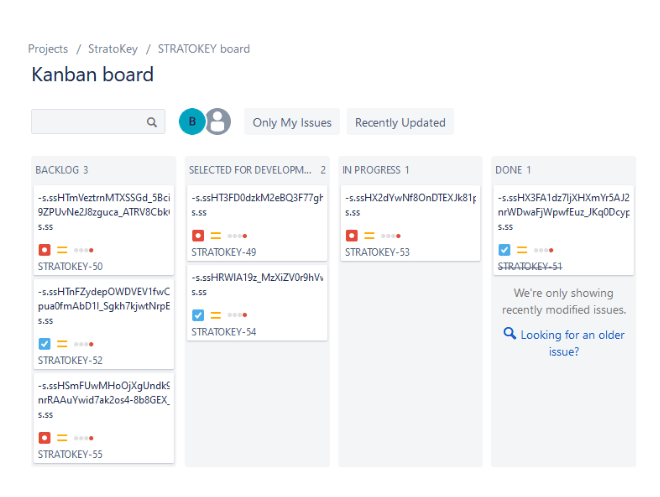
Encrypted fields appear as ciphertext in Jira.
Sensitive data never enters Jira’s servers in plain text.
Decryption requires your privately managed key, and StratoKey gateway access.
Why choose an encryption gateway over SaaS native encryption?
When using SaaS platform native encryption, the SaaS platform controls both encryption and decryption within its cloud environment, meaning there is no separation between your data and the third-party system. As a result, sensitive data remains exposed within SaaS platforms, increasing potential breach risk and limiting compliance with strict data protection requirements.
Even with BYOK key management, SaaS platforms still manage the encryption and decryption process, allowing the SaaS platform to access your data in plaintext within its environment.